Everyone is busy. But somehow, growth still feels stuck.
I’ve seen startup teams work late nights, handle multiple responsibilities, and push themselves beyond their limits just to keep the business moving.
Tasks get completed. Meetings happen. Deadlines are chased every single day.
But despite all the effort, many startups still struggle to scale.
Over time, I realized something important:
Startups usually don’t fail because people are lazy.
They struggle because hard work alone cannot compensate for the absence of structure.
At the beginning, startups survive through speed.
People take ownership naturally. Teams move fast. Problems get solved instantly because everyone is closely involved in everything.
And honestly, that phase feels exciting.
But as the business starts growing, the same fast-moving environment slowly begins creating operational pressure internally.
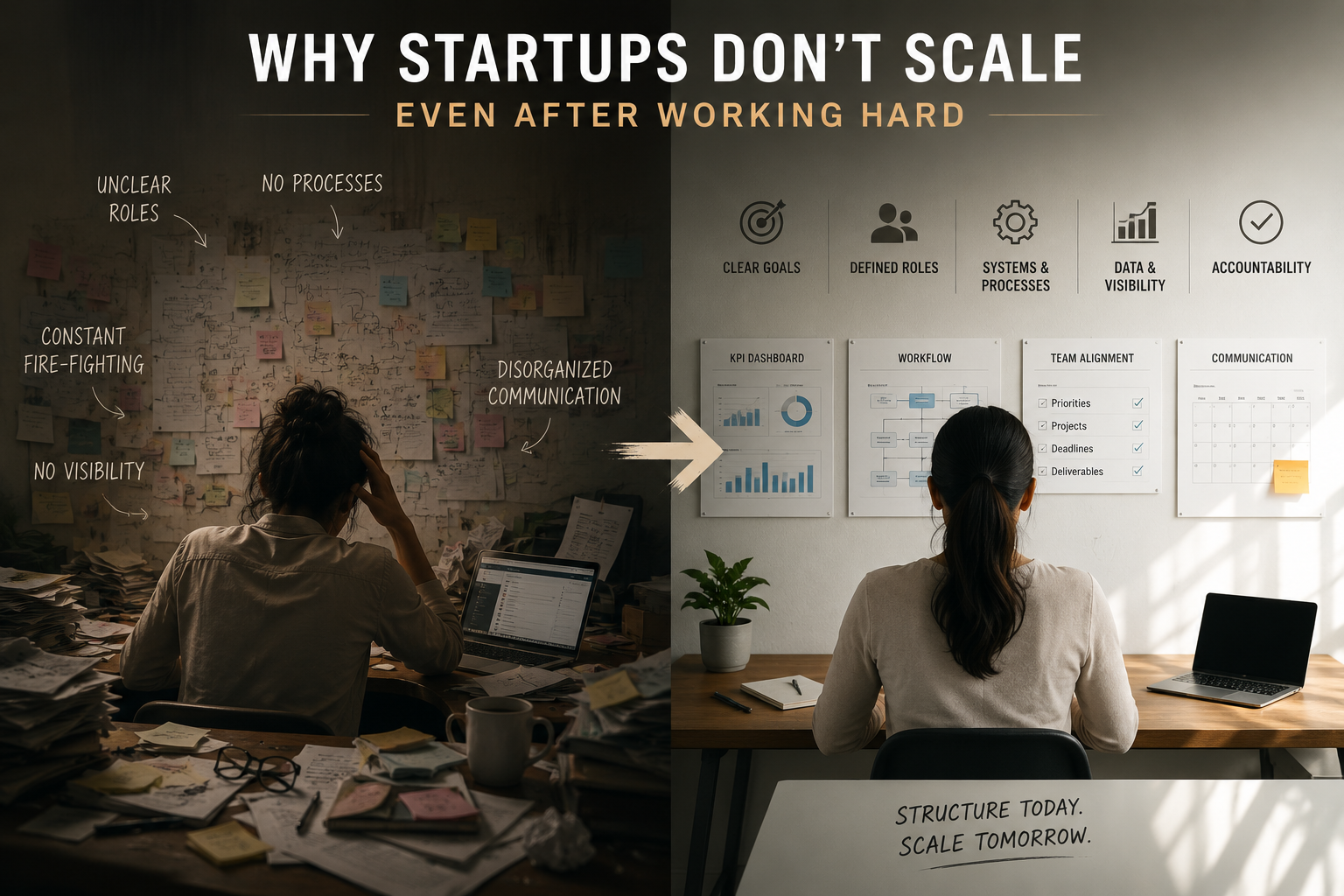
Communication gaps increase. Responsibilities become unclear. Teams depend too much on specific individuals. Reporting becomes inconsistent. Small inefficiencies start turning into daily bottlenecks.
What once felt like flexibility slowly turns into chaos.
One of the biggest challenges inside growing startups is that teams often mistake activity for progress.
Everyone is occupied.
But not everything being done is actually helping the business move forward strategically.
Without proper systems:
- work gets repeated,
- priorities keep shifting,
- decisions become reactive,
- and execution starts depending on memory instead of process.
This creates burnout very quickly.
Founders become involved in every small decision. Teams wait for approvals. Employees spend more time coordinating than executing.
And eventually, growth starts slowing down — not because the company lacks talent, but because the business lacks operational clarity.
This is where operations becomes extremely important.
Operations is not just about managing tasks or maintaining trackers.
Good operations creates visibility.
It reduces friction between teams.
It helps businesses scale without making people feel overwhelmed every single day.
Simple things like:
- Clear Ownership,
- Documented Workflows,
- Proper Reporting Structures,
- Accountability Systems,
- Organized communication
can completely change how a startup functions internally.
The difference becomes visible very quickly.
Teams perform better when expectations are clear.
Decision-making becomes faster when data is organized.
Businesses grow healthier when systems support execution.
Working closely with startup environments taught me that sustainable growth is never built on hustle alone.
Hard work may help a company survive initially.
But long-term scaling requires structure, systems, clarity, and operational discipline.
Because eventually, every growing startup reaches a point where effort alone is no longer enough.
And the companies that recognize this early are usually the ones that scale successfully.
If you’re building a startup and struggling with operational chaos, workflow inefficiencies, or scaling challenges, these are exactly the kinds of problems I love solving.
Subscribe to our newsletter
Get the latest insights delivered to your inbox.
Comments
Comments feature coming soon
We're working on adding comments to our blog.